Latest Update
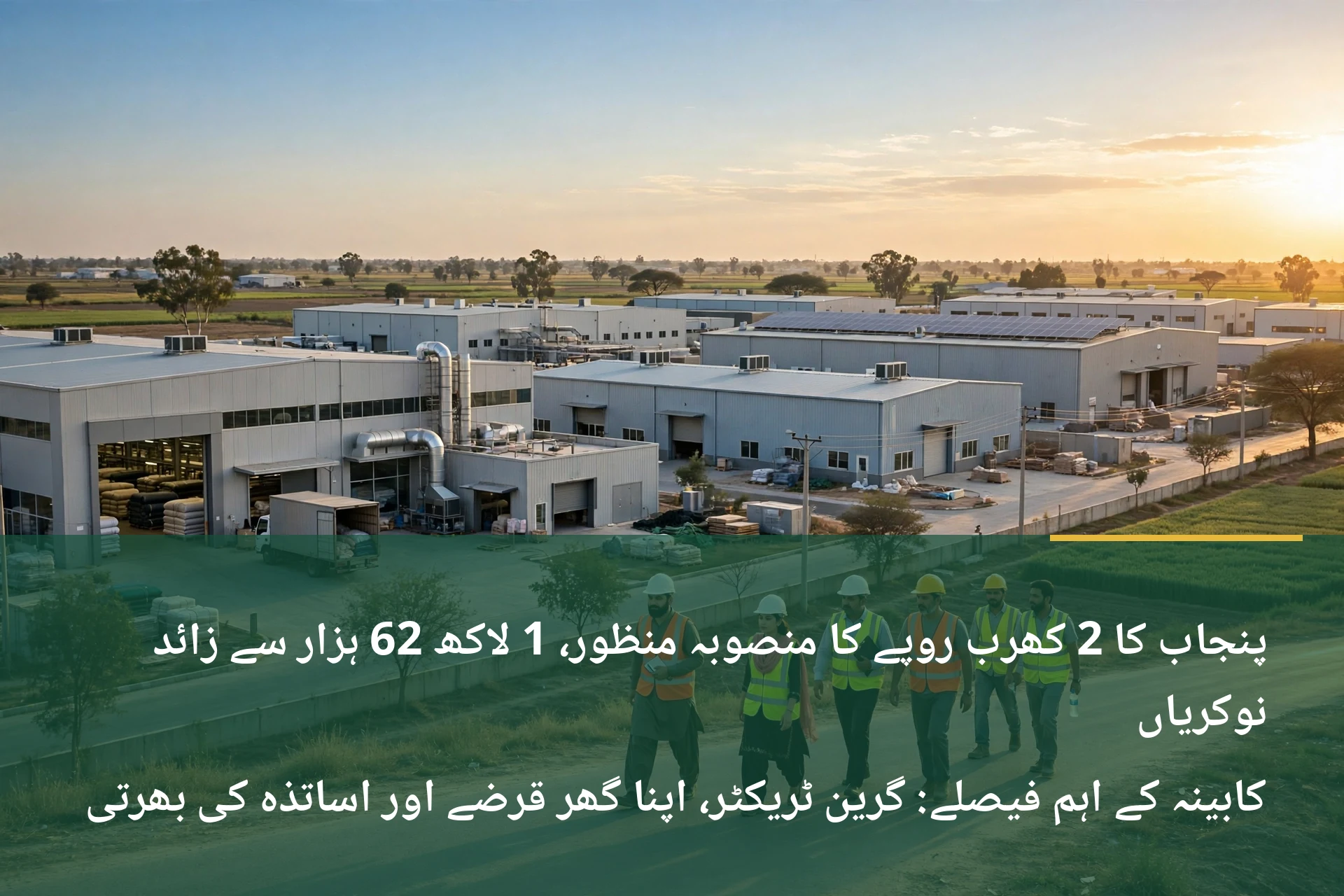
The Punjab cabinet has cleared an industrial development and export promotion programme worth Rs 1.995 trillion, expected to create more than 162,000 jobs. The approval came on October 20, 2026, at a meeting chaired by Chief Minister Maryam Nawaz Sharif, where Senior Minister Marriyum Aurangzeb presented the programme. The provincial government will provide Rs 1.089 trillion, while Rs 906 billion is expected from the private sector. The same sitting also approved decisions on tractors, housing loans, irrigation, teaching recruitment and electric buses.
Key Details
| Aspect | Detail |
|---|---|
| Total value | Rs 1.995 trillion (nearly Rs 2 trillion) |
| Government share | Rs 1.089 trillion |
| Private sector share | Rs 906 billion |
| Expected jobs | More than 162,000 |
| Approval date | October 20, 2026 |
| Chaired by | CM Maryam Nawaz Sharif |
| Presented by | Senior Minister Marriyum Aurangzeb |

What the Plan Covers
The programme aims to help factories produce more, export more and hire more people. Existing industries will get support to expand, and e-business and e-commerce will be promoted so smaller sellers can reach overseas buyers. Garments are included, along with plug-and-play facilities where new units can start production quickly.
Testing and certification services will be developed for leather, footwear and sports goods, while material-testing laboratories are planned for cutlery, handmade tools, ceramics and fan industries. Export financing will support horticulture and floriculture. The plan also covers agriculture processing parks in Sargodha, Khanewal, Okara and Bhakkar, wheat value enhancement, meat and milk value chains, citrus, potato and mango value addition, tourism and aquaculture, plus horticulture authorities in 20 districts.
Sector-by-Sector Breakdown
| Sector | Planned Support |
|---|---|
| Industry and garments | Expansion support; plug-and-play facilities |
| E-commerce | Help for online sellers and exporters |
| Leather, footwear, sports goods | Testing and certification services |
| Cutlery, tools, ceramics, fans | Material-testing laboratories |
| Horticulture, floriculture | Export financing |
| Agri-processing | Parks in Sargodha, Khanewal, Okara, Bhakkar |
| Food chains | Wheat, meat, milk, citrus, potato, mango |
What the Plan Means for Jobseekers
The figure of more than 162,000 jobs is encouraging, but these are projected jobs linked to investment, not a single recruitment drive. They are expected to appear gradually as factories expand, new units open and processing parks start working. Jobseekers should wait for separate hiring announcements from industries and departments. Initiatives like the CM Punjab Khud Mukhtar Program show that provincial employment schemes are normally advertised separately, with their own eligibility rules.
What It Means for Farmers
Farmers should benefit from processing parks creating nearby buyers, better value addition for wheat, citrus, potato and mango, and stronger meat and milk chains that can reduce waste and improve prices. Separately, the cabinet approved Rs 7.6 billion for drip irrigation, solar power and water storage across 10,000 acres in Mankera and Layyah under the Thal project, helping growers in water-scarce areas.
Other Major Decisions in the Same Meeting
- Green Tractor Program: New phase with Rs 9.5 billion subsidy for 10,000 high-powered tractors; over 250,000 applications received, around 25,000 tractors delivered so far, late registration fee waived, plus Phase IV low-powered tractor subsidies.
- Apni Chhat, Apna Ghar: Rs 60 billion approved; the CM rejected a proposal to impose stamp duty on the scheme.
- Health and education: Maryam Nawaz Medical College and Teaching Hospital approved for Mianwali; teaching interns to be recruited in government schools.
- Transport and recruitment: Operational arrangements for 1,500 electric buses at tehsil level; recruitment ban relaxed for several departments; higher traffic fines approved under the Punjab Ring Road Authority.
- Donations: 6 clinic-on-wheels vehicles for Gilgit-Baltistan and 15 for Azad Jammu and Kashmir.
Which Decisions Affect Ordinary Citizens Most?
Three decisions matter immediately. Teaching intern recruitment and the relaxed recruitment ban mean vacancies may be advertised soon, so candidates should keep documents ready. The waived tractor fee cuts costs for farmers. And because stamp duty was rejected, Apna Ghar applicants avoid an extra charge. The 1,500 tehsil-level electric buses should also ease daily travel.
Common Mistakes to Avoid
- Treating approval as an open application: Cabinet approval does not mean 162,000 posts are open today. Recruitment ads will come separately; never pay an agent who claims otherwise.
- Confusing tractor phases: The new phase covers 10,000 high-powered tractors, while Phase IV covers low-powered tractor subsidies. Check your category before applying.
- Assuming stamp duty applies: It does not. The stamp duty proposal for Apna Ghar loans was rejected.
- Misreading the funding split: Rs 1.089 trillion is from the Punjab government and Rs 906 billion from private investors; it is not one government grant.
FAQs
How big is the new Punjab industrial programme?
It is worth Rs 1.995 trillion: Rs 1.089 trillion from the provincial government and Rs 906 billion from the private sector.
How many jobs will the programme create?
More than 162,000 jobs are expected as industries expand and new projects start. They will appear gradually, not through one advertisement.
Which sectors are covered?
Garments, e-commerce, leather, footwear, sports goods, cutlery, handmade tools, ceramics, fans, horticulture, floriculture, tourism, aquaculture and food processing value chains.
Where will agriculture processing parks be set up?
In Sargodha, Khanewal, Okara and Bhakkar. Horticulture authorities will also be established in 20 districts.
What was decided about the Green Tractor Program?
A Rs 9.5 billion subsidy for 10,000 high-powered tractors was approved, the late registration fee was waived, and Phase IV low-powered subsidies were cleared. Around 25,000 tractors have been delivered so far.
Will stamp duty be charged on Apna Ghar loans?
No. Rs 60 billion was approved for the Apni Chhat, Apna Ghar programme, but the stamp duty proposal was rejected by the Chief Minister.
What else was approved for citizens?
Teaching intern recruitment, a medical college and teaching hospital in Mianwali, 1,500 electric buses at tehsil level, and Rs 7.6 billion for irrigation and solar projects in Mankera and Layyah.
Final Thoughts
The October 20 decisions pair long-term industrial investment with immediate relief for farmers, students and loan applicants. The programme will be judged by how quickly factories, laboratories and processing parks become operational and how many promised jobs reach local communities. Citizens should follow only official advertisements and avoid agents charging fees for approved schemes.