
Latest Update
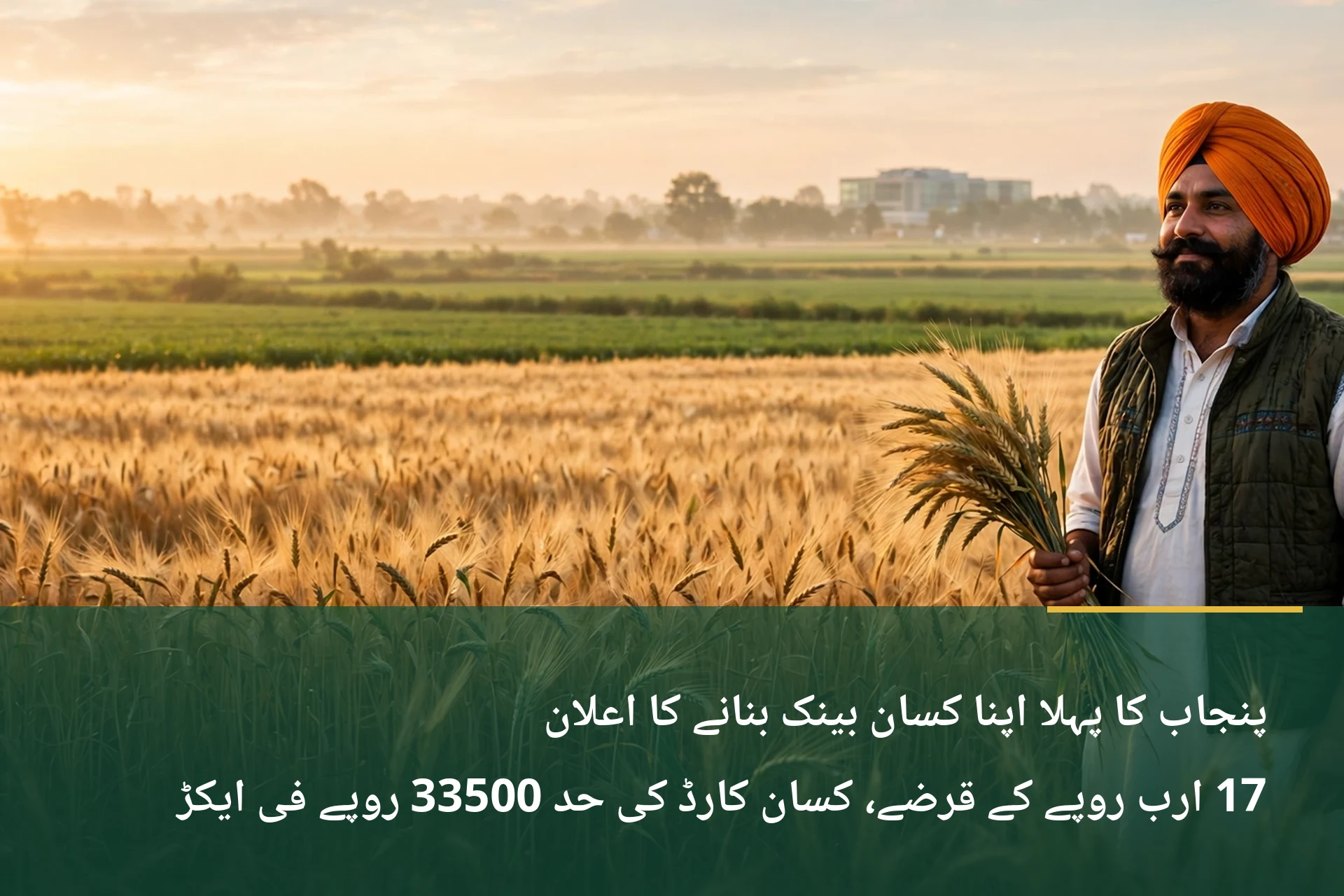
The Punjab government has announced a major new package for the province’s farmers, headlined by the province’s first dedicated farmers’ bank. Chief Minister Maryam Nawaz Sharif unveiled the measures on October 28, 2026, at a meeting with farmers’ representatives from across Punjab.
At the centre is the Apna Kisan Bank, alongside Rs 17 billion in subsidised farm financing for around five million acres. The package also raises the Kisan Card DAP limit, guarantees the wheat support price, and promises a digital wheat procurement system.
Key Details
| Announced by / on | Chief Minister Maryam Nawaz Sharif, October 28, 2026 |
| New bank | Apna Kisan Bank — Punjab’s first farmers’ bank (announced, not yet launched) |
| Financing package | Rs 17 billion in subsidised loans, covering around five million acres |
| Loan slabs | Up to Rs 10 million at zero markup; up to Rs 30 million at 2%; up to Rs 50 million at 5% |
| Kisan Card DAP limit | Raised from Rs 30,000 to Rs 33,500 per acre |
| Wheat support price | Rs 4,500 per maund, to be ensured with the federal government |
| Also announced | Wheat procurement portal; agro-parks in Sargodha, Bhakkar, Khanewal, Okara; olive subsidies in Potohar |

What Is the Apna Kisan Bank?
Punjab’s farmers have so far borrowed through general banks or informal lenders. The Apna Kisan Bank is meant to change that: an institution dedicated to agricultural finance, with credit designed around crop cycles — answering a longstanding demand of the farming community.
Be clear: the bank is announced, not opened. No launch date, branch list or application form exists yet, and any message or agent claiming otherwise — especially for a fee — is false.
How the Rs 17 Billion Loan Slabs Work
The financing will be offered through the Punjab Urban Unit in three slabs:
| Loan amount | Interest rate | Who it suits |
| Up to Rs 10 million | Zero markup | Small/medium farmers: inputs, machinery, working capital |
| Up to Rs 30 million | 2% interest | Medium farmers expanding or buying equipment |
| Up to Rs 50 million | 5% interest | Larger farms and agri-business |
For small farmers, the first slab matters most: up to Rs 10 million interest-free for seed, fertiliser, pesticides, diesel and machinery. Eligibility and documents will come with the formal notification — trust only the official announcement.
What Changes on the Kisan Card
The Kisan Card DAP limit rises Rs 3,500 per acre, from Rs 30,000 to Rs 33,500 — so ten acres now qualify for Rs 335,000 instead of Rs 300,000. Over one million small farmers already use the card to buy fertiliser, seeds and pesticides directly, without middlemen. This is separate from the card’s current recovery round — see our earlier report on the CM Punjab Kisan Card 4th installment, whose lucky-draw deadline was October 30, 2026.
Wheat Support Price of Rs 4,500 per Maund, Explained Simply
The support price is the minimum price the government commits to ensuring for wheat. At Rs 4,500 per maund, growers know their wheat will not sell below that level, with implementation coordinated with the federal government. But it only helps if procurement actually happens — hence the promised portal and plan — and it does not apply automatically to every open-market sale. Wait for the procurement plan for where, when and how wheat will be purchased.
Agro-Parks and the Potohar Olive Package
Agro-parks are planned in Sargodha, Bhakkar, Khanewal and Okara, where produce such as mangoes, kinnows, oranges and potatoes can be graded, stored and processed — so farmers can process crops and reach export markets instead of selling raw at harvest prices. Separately, a Potohar Transformation Package will subsidise olive cultivation in the Potohar region, whose hilly, rain-fed land suits olives better than traditional crops. Farmers were also asked not to burn crop residue (it worsens smog), with action promised against water theft.
What to Watch Next
Much of this package is still intent: its value depends on the bank’s launch date, loan eligibility and applications, the wheat portal and plan, and agro-park and olive-subsidy timelines. Until those details are official, no one can apply — and no fee is required.
Common Mistakes
Assuming the bank is open. It is only announced — never pay anyone claiming to open an account for you.
Confusing this package with the Kisan Card lucky draw — a separate incentive whose deadline was October 30, 2026.
Trusting agents who promise loans for a fee — government farm loans never require one.
Assuming the Rs 4,500 wheat price applies automatically — it works through the procurement system, still being set up.
Believing inflated figures on social media. The announced slabs are Rs 10 million interest-free, Rs 30 million at 2% and Rs 50 million at 5%.
Frequently Asked Questions
What is the Apna Kisan Bank?
Punjab’s first dedicated bank for farmers, announced October 28, 2026. It has not launched yet, and no account-opening process has been announced.
How much financing is included in the package?
Rs 17 billion in subsidised farm loans, covering around five million acres.
What are the loan slabs and interest rates?
Up to Rs 10 million interest-free, up to Rs 30 million at 2% interest, and up to Rs 50 million at 5% interest, offered through the Punjab Urban Unit.
How has the Kisan Card limit changed?
The DAP fertiliser limit rose Rs 3,500 per acre, from Rs 30,000 to Rs 33,500.
What is the wheat support price?
Rs 4,500 per maund, ensured with the federal government via a new online procurement portal and plan.
Can I apply for an Apna Kisan Bank loan now?
No — eligibility and the application process are unpublished. Wait for the official notification; never pay an agent.
Where are the agro-parks planned, and what is the Potohar package?
Agro-parks in Sargodha, Bhakkar, Khanewal and Okara; the Potohar package subsidises olive cultivation.
Final Thoughts
This is among Punjab’s biggest farmer-focused measures this year: a dedicated bank, Rs 17 billion in subsidised credit, a higher Kisan Card limit and a firm wheat support price tackle farmers’ three biggest costs — expensive credit, costly fertiliser and uncertain wheat prices. But announcements are only the first step: the real test is how fast the bank opens, how simple its loans are, and whether procurement delivers Rs 4,500 per maund at the mandi. Follow official announcements — and never pay anyone promising a loan from this package.