

HEC AI Course in Universities
HEC AI Course in Universities. Pakistan is taking an important step toward preparing students for the digital future. The Higher Education Commission (HEC) first directed public universities to introduce a mandatory artificial intelligence (AI) course in relevant degree programs — a policy that has since been expanded to cover all undergraduate and postgraduate degree programmes in both public and private universities from the Fall 2026 session. This initiative reflects the growing importance of AI in education, technology, business, and everyday life.
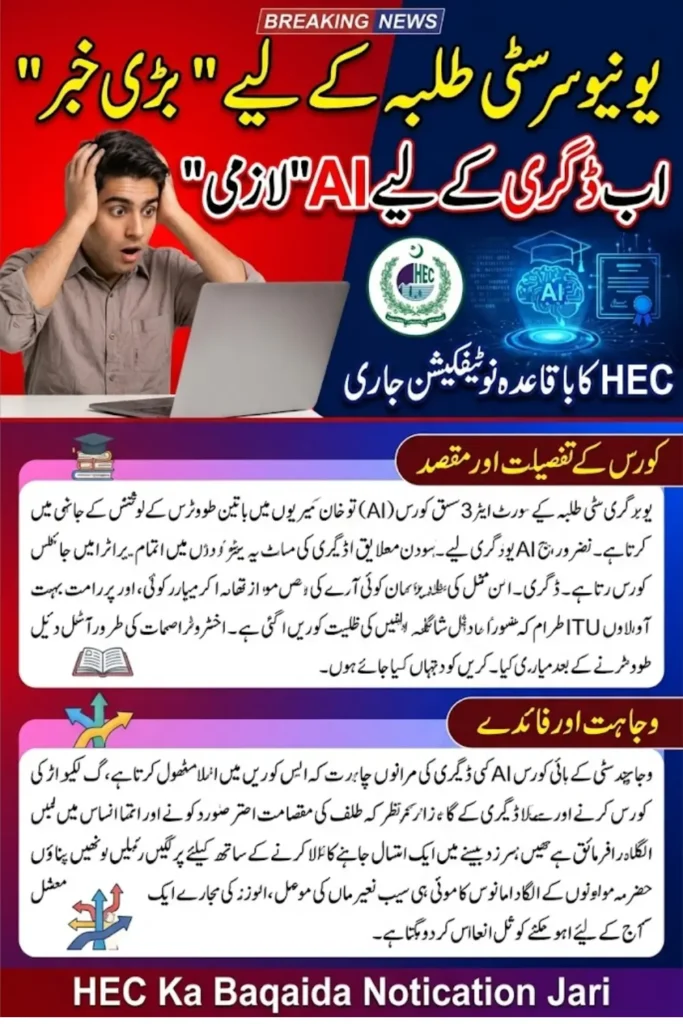
Under the new policy, universities will offer a 3-credit-hour course titled “Introduction to Artificial Intelligence” to help students understand the fundamentals of AI and its real-world applications. The move is expected to strengthen digital literacy and equip graduates with skills needed in an increasingly technology-driven world.
Latest Update (October 2026)
The AI course policy has been significantly expanded and formally ratified since it was first announced. In sweeping policy reforms approved in July 2026, the Higher Education Commission formally ratified the compulsory three-credit-hour Artificial Intelligence course for ALL undergraduate and postgraduate degree programmes — not just relevant disciplines — offered by both public and private universities, effective from the Fall 2026 academic session, which is now underway. Universities can offer the course as an elective, interdisciplinary subject or supporting course, and may tailor content to the discipline (for example, AI in healthcare versus AI in law). Source: The News, July 2026
The ratified policy requires the curriculum to cover foundational concepts of AI, machine learning and large language models (LLMs), along with ethical responsibility, data privacy and transparency, and the societal impact of AI on governance, the economy and the workforce. In the same meeting, the HEC also granted in-principle approval to a national framework governing the responsible use of Generative AI (Gen-AI) in higher education institutions, with formal notification expected after member recommendations are incorporated. Source: The News, July 2026
Separately, the Commission approved holding the National Standardized Computing Test (NSCT) twice every year from Fall 2026 onwards, making participation mandatory for all students enrolled in the seventh and eighth semesters of computing degree programmes across HEC-recognised universities. The Education Testing Council (ETC) has been assigned responsibility for conducting the examination. Source: The News, July 2026
HEC Directs Universities to Introduce Mandatory AI Course
The Higher Education Commission has officially instructed public-sector universities to include an AI course in relevant academic programs. According to the advisory, the course will be mandatory and will carry three credit hours.
The decision was also supported during a consultative meeting of vice-chancellors, where university leaders agreed on the need to promote AI education across higher education institutions. The initiative demonstrates HEC’s commitment to modernizing university curricula and ensuring students are prepared for future technological developments.
Details of the “Introduction to Artificial Intelligence” Course
The new course, titled “Introduction to Artificial Intelligence,” is designed to provide students with a basic understanding of AI concepts and technologies. It aims to introduce learners to the principles, applications, and impact of artificial intelligence in different sectors.
Students enrolled in the course are expected to learn about:
- Fundamentals of artificial intelligence
- Machine learning concepts
- AI applications in business and industry
- Ethical considerations in AI
- Future trends in intelligent technologies
- The role of AI in solving real-world problems
By studying these topics, students will gain valuable knowledge that can help them adapt to the evolving demands of the modern workforce.
Phased Implementation Across Universities
HEC has instructed universities to begin incorporating the AI course into their curricula immediately. However, the implementation process will take place in phases to ensure smooth integration into various degree programs.
Universities will gradually introduce the course across relevant disciplines while aligning it with existing academic structures. This phased approach allows institutions to make necessary adjustments and prepare faculty members for effective course delivery.
The goal is to ensure that students from different educational backgrounds can benefit from AI education without disrupting ongoing academic programs.
Information Technology University Lahore Develops Course Modules
To support the implementation process, Information Technology University (ITU) Lahore has prepared three proposed modules for the course. These modules provide a structured framework that universities can use while introducing AI education.
The course outlines developed by ITU Lahore are designed to ensure consistency and quality across institutions. They cover essential AI concepts and provide a foundation for students who may later pursue advanced studies in artificial intelligence and related fields.
The availability of standardized modules will help universities adopt the course more efficiently and maintain educational standards nationwide.
HEC Approval and Vice-Chancellors’ Support
The proposed course modules received approval during the 45th meeting of the Higher Education Commission. Following their approval, the outlines were shared with public-sector universities for implementation.
Vice-chancellors from various universities also endorsed the initiative during a consultative session. Their support highlights the growing recognition of AI as a critical area of knowledge for future graduates.
The collaborative approach between HEC, university leadership, and educational experts is expected to contribute to the successful adoption of AI education across Pakistan.
Punjab Universities Receive Official Instructions
As part of the nationwide initiative, a formal letter has been issued to all public universities in Punjab. The notification directs institutions to take practical steps toward introducing the AI course and promoting artificial intelligence education.
The move reflects a broader effort to ensure that higher education institutions remain aligned with global technological trends. Universities in Punjab are now expected to integrate AI learning opportunities into their academic programs and encourage students to develop digital competencies.
Benefits of the HEC AI Course in Universities
The introduction of the HEC AI Course in Universities offers several benefits for students, institutions, and the country’s digital economy.
Development of Future-Ready Skills
Artificial intelligence is rapidly transforming industries around the world. By learning AI concepts, students can acquire skills that will remain relevant in the future job market.
Improved Career Opportunities
Knowledge of AI can increase employability and open doors to careers in technology, data science, software development, automation, and emerging digital fields.
Enhanced Innovation and Research
The course can encourage students to explore innovative ideas and participate in research projects related to artificial intelligence and advanced technologies.
Stronger Digital Workforce
By introducing AI education at the university level, Pakistan can build a workforce capable of competing in the global digital economy and contributing to technological development.
AI’s Growing Role in Higher Education Policy
Artificial intelligence is becoming a central focus of educational strategies worldwide. Universities across the globe are incorporating AI-related subjects into their programs to prepare students for changing industry requirements.
Pakistan’s decision to make AI education part of university curricula aligns with these international trends. The initiative recognizes that digital transformation is reshaping the way businesses operate, governments deliver services, and societies function.
As AI continues to influence multiple sectors, educational institutions must ensure that graduates possess the knowledge and skills needed to succeed in a technology-driven environment.
Conclusion
Frequently Asked Questions
Is the HEC AI course mandatory for all degree programmes?
Yes. Following HEC’s ratification in July 2026, the compulsory three-credit-hour AI course applies to all undergraduate and postgraduate degree programmes in both public and private universities, effective from the Fall 2026 session.
How many credit hours does the AI course carry?
The course carries 3 credit hours and can be offered as an elective, interdisciplinary subject or supporting course within a degree programme.
What does the AI curriculum cover?
The mandated curriculum must cover foundational AI concepts including machine learning and large language models, plus ethical responsibility, data privacy and transparency, and AI’s societal impact on governance, the economy and the workforce.
Has HEC approved rules for the use of Generative AI in universities?
The HEC has granted in-principle approval to a national framework for the responsible use of Generative AI (Gen-AI) in higher education institutions; formal notification is expected after further recommendations are incorporated.
Conclusion
The introduction of the HEC AI Course in Universities marks a significant milestone in Pakistan’s higher education sector. What began as a directive for relevant programmes has now been ratified as a compulsory 3-credit-hour AI course for all undergraduate and postgraduate degree programmes in public and private universities, effective from the Fall 2026 session that is now underway.
With approved course modules, support from university leadership, formal implementation instructions, and a responsible-use framework for Generative AI on the way, the initiative is expected to strengthen AI education across the country. As universities integrate artificial intelligence into their curricula, students will gain valuable knowledge that can enhance their academic growth, career prospects, and contribution to Pakistan’s digital future.
Fly Jinnah Karachi to Dammam Flights Launching from July 2026