

HEC National Skills Competency Test 2026 Results
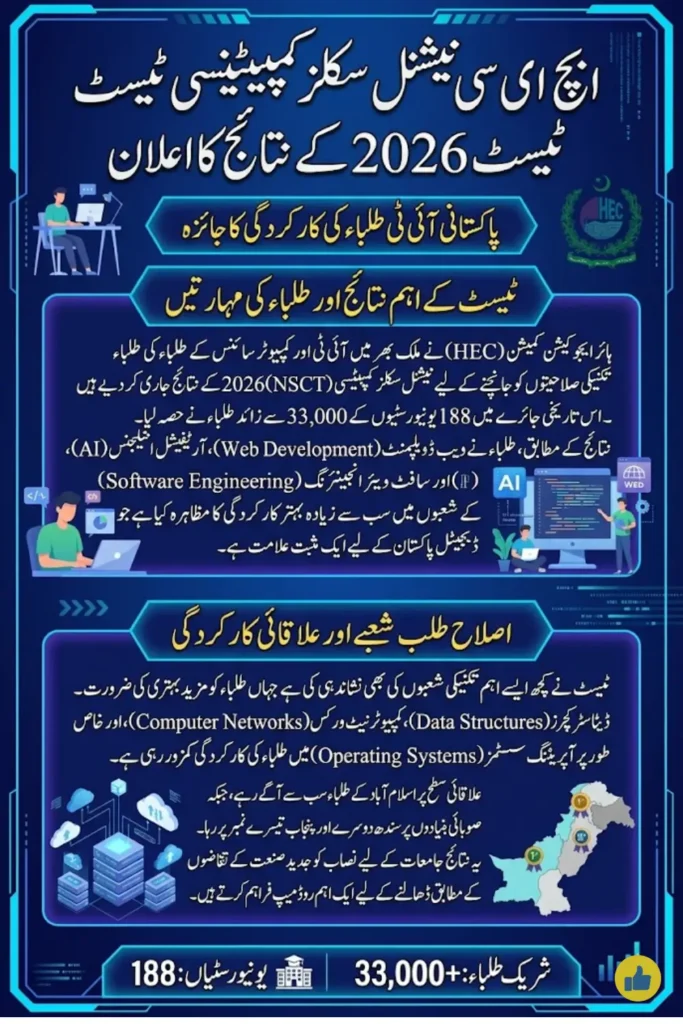
HEC National Skills Competency Test 2026 Results. The Higher Education Commission (HEC) has officially announced the results of the National Skills Competency Test (NSCT) 2026, marking a significant milestone for Pakistan’s higher education sector. The assessment is the country’s first nationwide benchmark designed to evaluate the technical skills of university students studying Information Technology (IT) and Computer Science.
The HEC National Skills Competency Test 2026 Results provide valuable insights into the strengths and weaknesses of students across various technology-related disciplines. The findings are expected to help universities improve academic programs, address skill gaps, and prepare graduates for the rapidly evolving technology industry.
HEC Announces National Skills Competency Test 2026 Results
The National Skills Competency Test (NSCT) 2026 was introduced by HEC to assess the practical and theoretical knowledge of students enrolled in IT and computer science programs. The initiative aims to create a nationwide benchmark that can measure the readiness of graduates for modern industry requirements.
According to HEC, the results offer a detailed overview of student performance in several critical technology domains. The assessment not only highlights areas where students excel but also identifies fields that require further attention and improvement.
Participation Statistics of NSCT 2026
The HEC National Skills Competency Test 2026 attracted participation from universities across Pakistan, making it one of the largest assessments of IT students in the country.
Key participation statistics include:
- More than 40,000 students registered for the test.
- Students from 188 universities participated.
- Over 33,000 IT and computer science students were assessed.
- The examination was conducted on April 4 and 5, 2026.
The large number of participants reflects the growing interest in technology education and the importance of skills-based assessments in Pakistan.
Key Findings from HEC National Skills Competency Test 2026 Results
The NSCT 2026 findings provide a comprehensive picture of the capabilities of IT students across Pakistan. While students performed relatively well in certain technical areas, the assessment also revealed significant opportunities for improvement in others.
The results indicate that students generally possess a solid understanding of web development and emerging technologies such as artificial intelligence. However, foundational areas like operating systems, networking, and data structures require stronger academic focus.
Top Performing IT Skill Areas
The HEC National Skills Competency Test 2026 Results highlighted several areas where students demonstrated comparatively strong performance.
Web Development Basics Leads Performance
Web Development Basics emerged as the highest-performing category in the assessment.
- Performance Score: 54.1%
This result suggests that students are gaining practical knowledge in website development and related technologies, which continue to be in high demand across the technology sector.
Artificial Intelligence and Machine Learning
Artificial Intelligence (AI) and Machine Learning ranked among the strongest areas.
- Performance Score: 50.8%
The growing popularity of AI-related fields may have contributed to better student understanding and engagement in this domain.
Software Engineering
Software Engineering secured the third position among the best-performing categories.
- Performance Score: 50.1%
This indicates that students have a reasonable understanding of software development methodologies, project management concepts, and application design principles.
Problem Solving and Analytics
Problem-solving abilities remain an essential skill for technology professionals.
- Performance Score: 49.1%
Students demonstrated moderate competency in analytical thinking and logical reasoning, which are crucial for successful careers in technology.
Programming Skills
Programming was another area where students showed encouraging performance.
- Performance Score: 47.8%
Although the score is close to the improvement threshold, it reflects a foundational understanding of coding concepts among participants.
Areas Requiring Improvement
While the assessment revealed several strengths, it also identified critical areas where students need additional support and training.
Cyber Security
Cyber Security was highlighted as an area requiring further improvement.
- Performance Score: 47.2%
As cyber threats continue to increase globally, strengthening cybersecurity education has become increasingly important for universities.
Database Systems
Database Systems recorded a lower performance score.
- Performance Score: 42.3%
The results suggest that students may need more practical exposure to database management and data handling techniques.
Data Structures and Algorithms
Data Structures and Algorithms remain fundamental components of computer science education.
- Performance Score: 40.2%
The findings indicate that students need stronger conceptual understanding and problem-solving practice in this area.
Computer Networks and Cloud Computing
Computer Networks and Cloud Computing also emerged as weak areas.
- Performance Score: 39.6%
Given the growing importance of cloud technologies, universities may need to update their curricula to better align with industry trends.
Operating Systems
Operating Systems recorded the lowest score among all evaluated categories.
- Performance Score: 33.8%
The results suggest a significant knowledge gap that educational institutions may need to address through improved teaching methods and practical learning opportunities.
Provincial and Regional Performance Comparison
The HEC National Skills Competency Test 2026 Results also revealed noticeable differences in student performance across various regions of Pakistan.
Islamabad Capital Territory (ICT) Tops the Ranking
Islamabad Capital Territory achieved the highest pass rate in the assessment.
- Pass Rate: 52.9%
The strong performance may reflect better access to educational resources, technology infrastructure, and academic opportunities.
Sindh
Sindh secured the second position nationwide.
- Pass Rate: 42.0%
Punjab
Punjab followed closely behind Sindh.
- Pass Rate: 39.4%
Gilgit-Baltistan
Gilgit-Baltistan demonstrated moderate performance.
- Pass Rate: 32.6%
Azad Jammu and Kashmir (AJK)
- Pass Rate: 31.0%
Khyber Pakhtunkhwa (KP)
- Pass Rate: 30.2%
Balochistan
Balochistan recorded the lowest pass rate among all regions.
- Pass Rate: 29.0%
These regional differences highlight the need for targeted educational improvements and greater access to quality IT education across all provinces.
What the HEC National Skills Competency Test 2026 Results Mean for Universities
The NSCT 2026 assessment provides universities with valuable data that can be used to strengthen academic programs and improve student outcomes.
The results can help institutions:
- Evaluate the effectiveness of current curricula.
- Identify critical skill gaps among students.
- Introduce industry-relevant learning opportunities.
- Improve teaching methodologies.
- Enhance practical and hands-on training.
- Better prepare graduates for professional careers.
By using this data effectively, universities can align educational programs with modern industry requirements and improve the employability of graduates.
Impact on Pakistan’s Future IT Workforce
Pakistan’s technology sector continues to expand, creating increasing demand for skilled professionals. The HEC National Skills Competency Test 2026 Results offer an important roadmap for strengthening the country’s future workforce.
The assessment can contribute to:
- Building a highly skilled IT workforce.
- Supporting innovation and digital transformation.
- Enhancing Pakistan’s competitiveness in the global technology market.
- Preparing students for emerging technologies such as Artificial Intelligence and Cloud Computing.
- Bridging the gap between academic learning and industry needs.
As technology continues to shape economies worldwide, developing strong technical competencies among graduates will remain a national priority.
Conclusion
The HEC National Skills Competency Test 2026 Results represent a major step forward in evaluating and improving technology education in Pakistan. With more than 33,000 students assessed from 188 universities, the test provides the first comprehensive national benchmark of IT and computer science skills.
The results reveal encouraging performance in areas such as Web Development, Artificial Intelligence, and Software Engineering, while also highlighting the need for improvement in Cyber Security, Operating Systems, Data Structures, and Cloud Computing.