
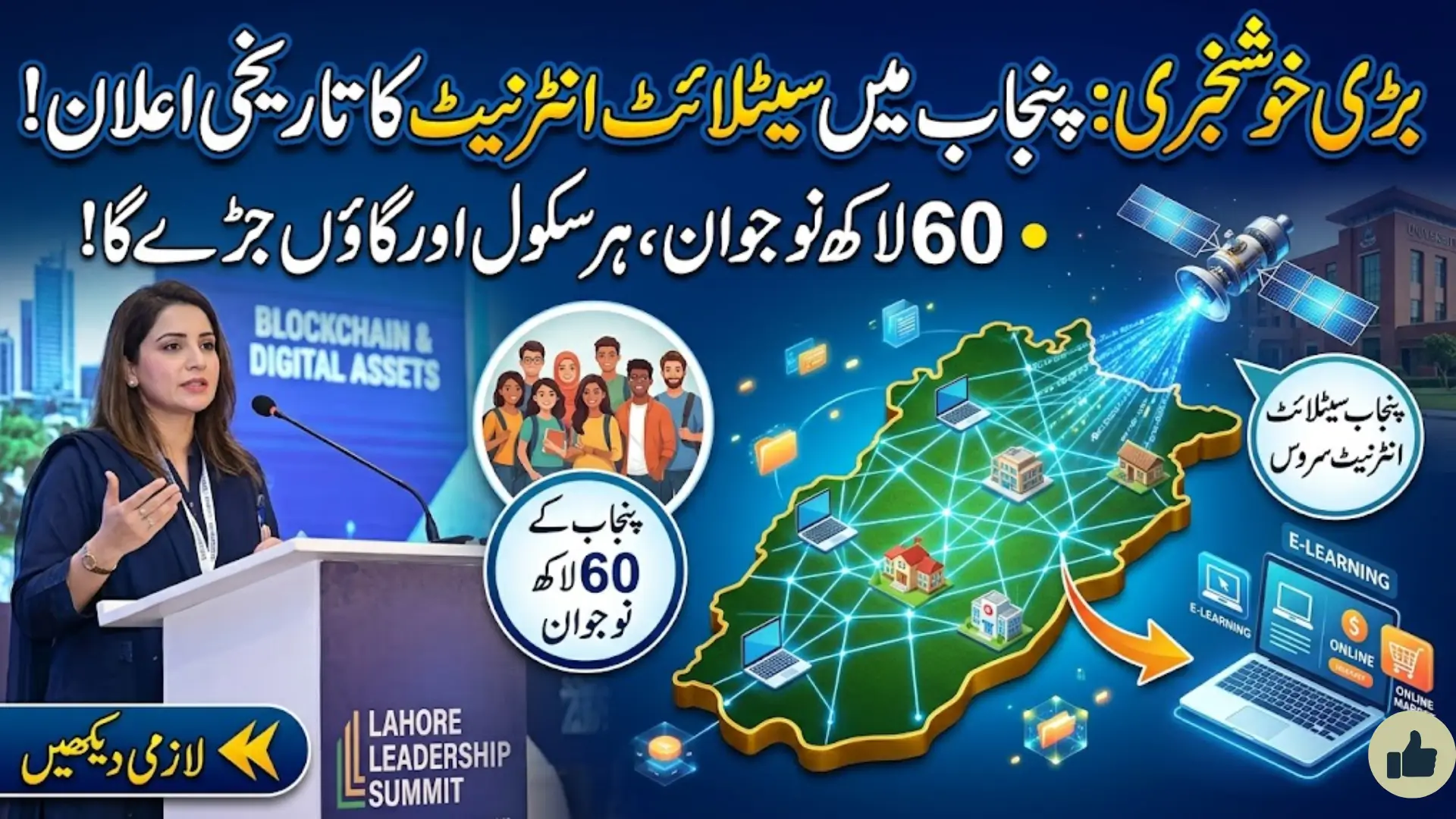
Punjab Satellite Internet Service
Punjab Satellite Internet Service. Punjab has taken a bold and forward-looking decision to introduce satellite internet service across the province. This announcement marks a significant milestone in Punjab’s journey toward becoming a digitally connected and technologically advanced province. The initiative aims to bring high-speed internet access to every corner of Punjab, including the most remote and underserved areas that have long been left behind in the digital age.
Latest Update (October 2026)
New details have emerged about how Punjab plans to deliver on its satellite internet promise. In a high-level meeting at the Chief Minister’s Office chaired by Senator Anusha Rahman in January 2026, it was announced that Punjab will become the first province in Pakistan where citizens benefit from broadband services through Pakistan’s own satellite, with detailed consultations held on providing high-speed broadband under Chief Minister Maryam Nawaz Sharif’s directions. Source: The News / The Nation, Jan 2026
At the national level, however, commercial satellite internet is still waiting on regulation. As of September 2026, the Senate Standing Committee on Information Technology and Telecommunication was grilling the PTA over the delay: Starlink’s registration with the Pakistan Space and Upper Atmosphere Research Board (PSARB) remains incomplete, holding back its bid for a PTA licence, even though it has registered locally with the SECP as Starlink Internet Services Pakistan (Pvt.) Ltd. The PTA chairman told the committee that four to five satellite internet companies are currently interested in entering the Pakistani market — Starlink, Shanghai Spacecom (SSST), OneWeb of the Eutelsat Group, Amazon’s Project Kuiper and Canada’s Telesat — but none has been licensed yet, because the space regulations and the Fixed Satellite Service (FSS) licensing framework are still going through the government’s approval process, alongside mandatory security clearances. Source: TechJuice / Digital Pakistan, Sep 2026
In short: Punjab’s public-sector satellite broadband push via the national satellite is separate from the commercial constellations, which cannot formally begin services until Islamabad finalises the regulatory framework. On the wider digital roadmap, Senator Rahman has also announced plans for specialised AI and blockchain incubators in Lahore, Faisalabad and Sahiwal, alongside the skills programme targeting six million young people — including women — over the next four years. Source: TechnologyPlus, May 2026
Announcement at Lahore Leadership Summit
The decision to launch Punjab satellite internet service was announced by PML-N leader and Punjab Chief Minister’s Senior Adviser Senator Anusha Rahman. She made this important announcement while speaking at a leadership summit held at a private university in Lahore.
The summit was centered around blockchain technology and digital assets, bringing together thought leaders, technology experts and government representatives under one roof. Participants engaged in rich discussions about the role of emerging technologies in shaping Pakistan’s digital future. The event served as the perfect platform to unveil such a transformative connectivity initiative for the province.
Punjab’s Focus on High-Speed Internet in Underserved Areas
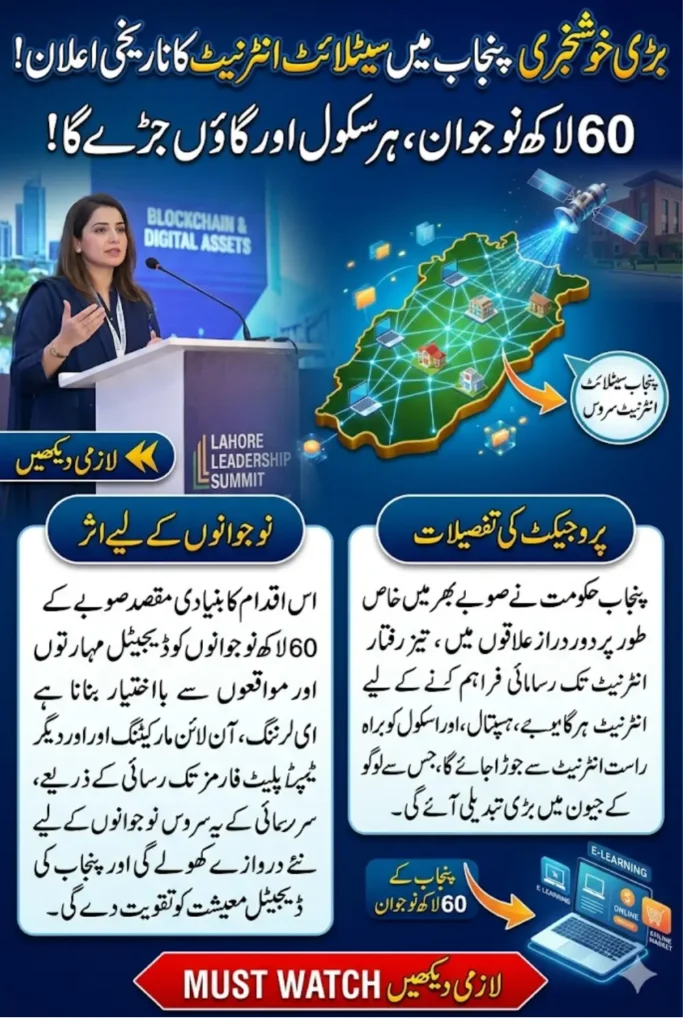
Senator Anusha Rahman made it clear that the Punjab government is placing a strong focus on providing high-speed internet access to underserved areas across the province. For years, millions of people living in rural and remote regions of Punjab have struggled with little or no internet connectivity, limiting their access to education, healthcare information, economic opportunities and government services.
The introduction of Punjab satellite internet service is a direct response to this long-standing challenge. Unlike traditional internet infrastructure that requires expensive physical cables and towers, satellite internet can reach areas where ground-based connectivity is simply not possible. This makes it an ideal solution for bridging the digital divide in Punjab’s most disconnected communities.
Connecting Villages, Schools, Colleges and Hospitals
One of the most impactful aspects of Punjab satellite internet service is its focus on connecting essential institutions and communities. Senator Rahman specifically highlighted that satellite internet will help connect villages, schools, colleges and hospitals across the province.
This is a game-changing development. When a village gets connected to the internet, its residents gain access to online markets, government services and digital education. When schools and colleges are connected, students can benefit from e-learning platforms, digital libraries and online resources that were previously out of their reach. When hospitals are connected, healthcare professionals can access telemedicine services, updated medical research and digital health records, ultimately improving the quality of care for patients in remote areas.
Senator Rahman also acknowledged that people across Punjab already show a strong interest in using digital technology. However, many areas still lack the basic connectivity needed to fulfill that interest. Satellite internet is the solution that will finally make this possible.
“Connect the Unconnected” Mission
To formally address the connectivity gap, the Punjab government has launched a dedicated mission called “Connect the Unconnected.” This mission reflects the government’s firm commitment to ensuring that no community, village or institution is left behind in Punjab’s digital transformation journey.
The “Connect the Unconnected” mission is not just a slogan. It is a structured policy direction that will guide investments, planning and implementation of satellite internet and other connectivity projects across the province. It sends a clear message that digital access is being treated as a basic right rather than a luxury in Punjab.
Government’s Plan to Provide Internet Through Satellite Technology
Senator Rahman confirmed that the government plans to provide internet through satellite technology in the public sector, meaning that government institutions, public schools, hospitals and administrative offices will be among the first to benefit. In January 2026 she clarified at the Chief Minister’s Office that Punjab aims to deliver this broadband through Pakistan’s own satellite — the first such provincial use of the national satellite.
The provincial IT Department is already actively working on modern connectivity projects to support this mission. Citizens should note, though, that commercial satellite internet services (such as Starlink) remain unlicensed in Pakistan as of September 2026, with the PTA still finalising the FSS licensing framework and space regulations — so Punjab’s public-sector rollout and commercial satellite broadband are two separate timelines.
Connecting 6 Million Youth With Modern Technology
Perhaps one of the most ambitious and exciting elements of this initiative is the government’s plan to connect 6 million young people with modern technology over the next four years. This target reflects a deep understanding that young people are the driving force behind any digital economy.
By connecting millions of young Punjabis to the internet and modern technology, the government is investing in the future of the province. Young people with internet access can pursue online education, develop digital skills, explore freelancing opportunities and participate in the global digital economy. This can dramatically reduce youth unemployment, boost innovation and create a new generation of tech-savvy professionals in Punjab.
Conclusion
Frequently Asked Questions
Is satellite internet available in Punjab yet?
The “Connect the Unconnected” mission has been launched and the government is working on a public-sector rollout — aiming to use Pakistan’s own satellite to serve schools, hospitals and government offices first. A consumer launch timeline has not yet been announced.
Is Starlink available in Pakistan?
No. As of September 2026, Starlink has not received a PTA licence: its PSARB registration is incomplete and the FSS licensing framework is still awaiting government approval. Five companies (Starlink, Shanghai Spacecom, OneWeb, Amazon Kuiper, Telesat) are waiting for licences.
What is the “Connect the Unconnected” mission?
A dedicated Punjab government campaign to bring digital connectivity — starting with satellite broadband in the public sector — to villages, schools, colleges, hospitals and other underserved areas of the province.
What is the 6 million youth target?
The Punjab government plans to connect six million young people with modern technology over four years, backed by AI and blockchain incubators planned for Lahore, Faisalabad and Sahiwal.
Conclusion
Punjab’s decision to launch satellite internet service is more than just a connectivity project. It is a vision for a more equal, empowered and digitally inclusive province. Through the “Connect the Unconnected” mission, the focus on villages, schools, colleges and hospitals, the plan to use Pakistan’s own satellite for provincial broadband, and the ambitious goal of connecting 6 million young people, the Punjab government is laying the foundation for a stronger digital future — even as commercial satellite services nationally still await their licences. Punjab satellite internet service has the potential to transform lives, unlock opportunities and position Punjab as a true leader in Pakistan’s growing digital landscape.