

Sindh Wheat Support Price
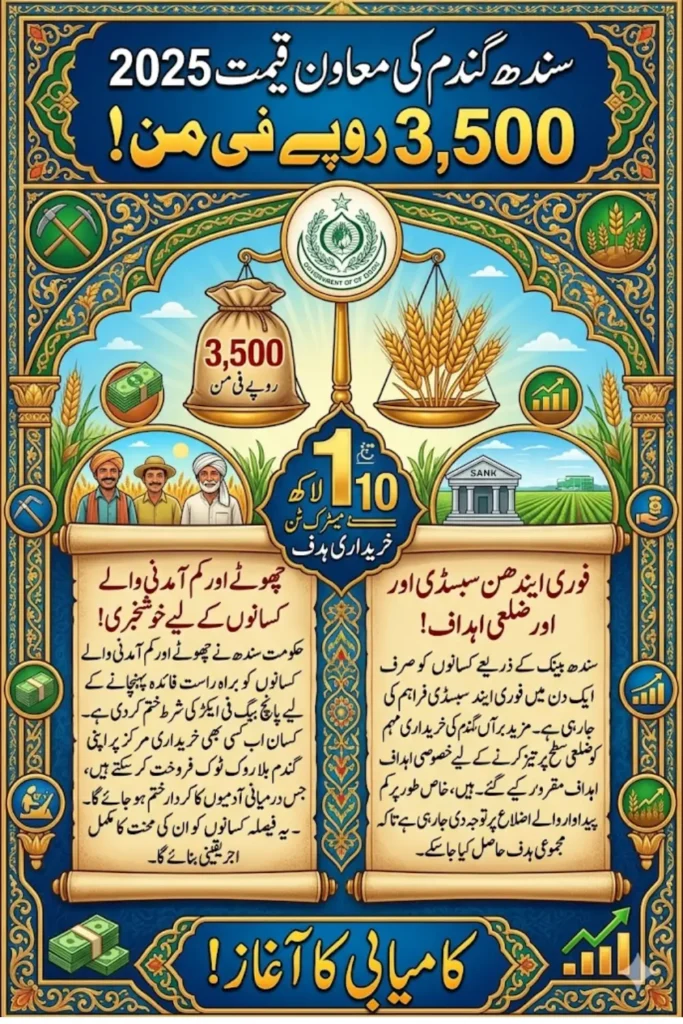
Sindh Wheat Support Price. Agriculture is the backbone of Pakistan’s economy, and farmers are the people who keep this backbone strong. Yet for years, small farmers have struggled to get fair prices for their hard-earned crops. The Sindh government has now taken a bold and farmer-friendly step by announcing the Sindh Wheat Support Price at Rs3,500 per maund, along with a wheat procurement target of 1 million metric tons. This decision is being widely welcomed as a major move to protect farmers’ interests and strengthen the agriculture sector across the province.
Program Overview: What Is the Sindh Wheat Support Price Policy?
The Sindh Wheat Support Price policy is a government initiative designed to guarantee farmers a fair and fixed price for their wheat crop during the procurement season. By setting the support price at Rs3,500 per maund, the Sindh government is sending a clear message that it stands firmly behind its farming community.
Sindh Information Minister Sharjeel Inam Memon announced the decision, describing it as a reflection of the government’s farmer-friendly approach. He stated that the procurement target of 1 million metric tons has been set with a firm commitment to achieving it, and that all necessary measures are being put in place to ensure the policy delivers real benefits to growers across Sindh.
End of Wheat Sales Limit and Removal of Five Bag Condition
One of the most significant changes introduced alongside the Sindh Wheat Support Price announcement is the decision to end the wheat sales limit and remove the condition of five bags per acre. Previously, this restriction meant that farmers could only sell a limited quantity of wheat at official procurement centers, which created serious challenges especially for those with larger harvests.
By removing this condition, the government has opened the door for growers to sell their produce more freely and without unnecessary bureaucratic barriers. Farmers no longer need to worry about hitting an artificial ceiling on how much wheat they can sell through official channels. This change is expected to make a meaningful difference in how smoothly the procurement season operates and how much wheat actually reaches government centers this year.
Direct Benefits for Small and Low-Income Farmers
The heart of the Sindh Wheat Support Price policy lies in its focus on supporting small and low-income cultivators. In the past, smaller farmers often faced the most difficulties in accessing government purchasing channels due to various restrictions and conditions that were difficult for them to meet.
With the removal of these barriers, small farmers can now walk into official procurement centers and sell their wheat without facing unnecessary hurdles. This means they no longer have to rely on middlemen who often buy crops at prices far below the official support price, leaving farmers with much less than they deserve.
Minister Memon emphasized that this policy change will ensure better price realization for small farmers, putting more money directly into their hands. When farmers earn better incomes, they invest more in their land, buy better seeds, and contribute more strongly to the overall agricultural output of the province.
Procurement Campaign and District-Level Targets
To make the Sindh Wheat Support Price policy a success on the ground, authorities have been directed to accelerate the wheat procurement campaign without delay. The government is fully aware that setting a target is only meaningful if it is actually achieved, which is why special attention is being given to districts where procurement levels have historically remained low.
Targeted measures will be taken in these underperforming districts to boost activity at procurement centers, ensure adequate staffing, and remove any local obstacles that may slow the process. This district-level focus reflects a mature and practical approach to policy implementation that goes beyond simple announcements.
Role of Sindh Bank and Fuel Subsidies
A particularly impressive feature of the Sindh Wheat Support Price initiative is the role being played by Sindh Bank in providing fuel subsidies to farmers. What makes this especially noteworthy is the speed of delivery — farmers are receiving their fuel subsidies within just one day of applying.
Minister Memon highlighted this as a strong example of transparency and efficiency in government service delivery. Timely payments worth millions of rupees have already been disbursed, and this promptness has gone a long way in building trust and confidence among the farming community. When farmers see that the government delivers on its promises quickly, they are more likely to engage with official procurement channels and benefit fully from the support price policy.
Conclusion
The Sindh Wheat Support Price of Rs3,500 per maund, combined with the 1 million metric ton procurement target and the removal of sales restrictions, represents a comprehensive and genuinely farmer-friendly policy package. By focusing on small cultivators, accelerating procurement campaigns, and ensuring fast fuel subsidy payments through Sindh Bank, the government has shown that it is serious about transforming the lives of farmers across the province. If implemented with consistency and transparency, this policy has the power to bring lasting positive change to Sindh’s agriculture sector and give hardworking farmers the fair deal they truly deserve.
Lenovo ThinkPad T14 Gen 7 Officially Launched – Full Details Inside