

Green School Program Punjab
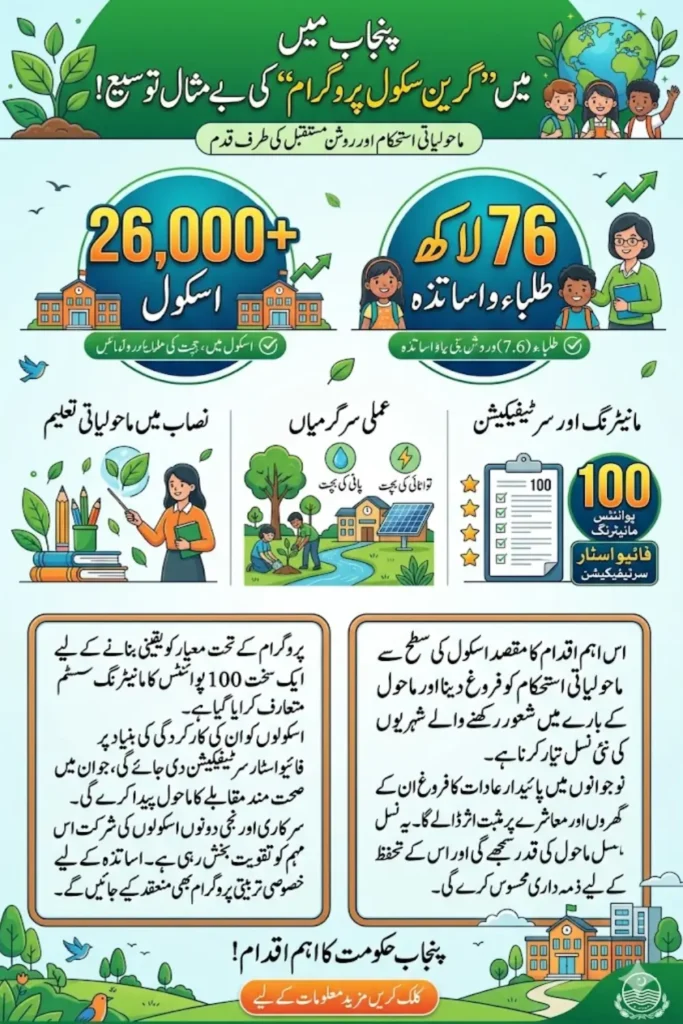
Punjab is taking a bold step toward a greener tomorrow. The provincial government has significantly expanded the Green School Program Punjab, bringing more than 26,000 schools under its umbrella. This landmark initiative is designed to promote environmental sustainability and build a generation of eco-conscious citizens from the classroom level.
Scale of the Green School Program Punjab
The numbers behind this initiative are truly impressive. According to Silwat Saeed, over 7.6 million students and teachers have already been registered under the Green School Program Punjab. This makes it one of the largest environmental education drives in the region. The program is not limited to a handful of institutions — it spans thousands of schools across the entire province, reflecting the government’s serious commitment to environmental responsibility at a grassroots level.
Environmental Education Now Part of the Curriculum
One of the most significant achievements of this program is that environmental education has been formally integrated into the school curriculum. Students are no longer just reading about environmental issues in theory. Practical measures for air quality improvement, water conservation, and energy saving have been actively implemented within school premises.
As a result, eco-friendly activities are steadily increasing across educational institutions in Punjab. From tree plantation drives to energy-saving practices, schools are becoming living examples of sustainability. The Green School Program Punjab is ensuring that environmental lessons go beyond textbooks and become part of everyday school life.
Training Students for Responsible Lifestyles
At the heart of this initiative lies a powerful goal — to train students in adopting environmentally responsible lifestyles. When young people learn sustainable habits early, they carry those values into their homes, communities, and eventually into their professional lives.
The Green School Program Punjab is not just about planting trees or saving water. It is about shaping mindsets. It is about creating a generation that understands the value of the environment and feels personally responsible for protecting it. This kind of awareness, built during school years, can have a lasting positive impact on Punjab’s environmental future.
Strict 100-Point Monitoring and Five-Star Certification
To ensure quality and accountability, authorities have introduced a strict 100-point monitoring system. Under this framework, schools are evaluated on their environmental practices and overall performance. Based on their scores, schools can earn a five-star certification, which serves as a recognition of their commitment to green practices.
This certification system adds a healthy sense of competition among schools. It encourages institutions to perform better, implement more sustainable practices, and continuously improve their environmental standards. The monitoring system ensures that the Green School Program Punjab is not just a policy on paper but a measurable, results-driven initiative.
Strong Participation from Public and Private Schools
The response from educational institutions has been highly encouraging. More than 80% of public schools have already joined the Green School Program Punjab. This wide-scale adoption within the public sector shows strong institutional support for the initiative.
Equally promising is the growing interest from private schools, which are also beginning to participate in the program. When both public and private institutions move in the same direction, the collective impact becomes far greater. This unified approach strengthens the program’s reach and ensures that environmental education touches students across all socioeconomic backgrounds.
Teacher Training and Citywide Awareness Sessions
A program of this scale cannot succeed without well-prepared educators. Recognizing this, officials have announced dedicated training programs for teachers to equip them with the knowledge and tools needed to effectively deliver environmental education. Trained teachers are key to making the program meaningful and impactful in real classrooms.
Additionally, special awareness sessions will be held in major cities across Punjab. These sessions will spread the message of sustainability beyond school walls and engage the wider community in the green movement.
International Organizations Strengthen the Program
The Green School Program Punjab has also attracted the attention of international organizations, which are now joining efforts to support the initiative. This global partnership brings additional resources, expertise, and credibility to the program. It also signals that Punjab’s environmental education model is gaining recognition beyond national borders, further motivating local stakeholders to keep the momentum going.
Conclusion
The expansion of the Green School Program Punjab marks a defining moment in the province’s educational and environmental journey. With over 26,000 schools, 7.6 million registered participants, a rigorous monitoring system, growing international support, and eco-friendly education woven into the curriculum, Punjab is building a strong foundation for a sustainable future. The program proves that real environmental change begins in the classroom — and Punjab is leading the way.
5G Services in Pakistan Launched in 22 Cities: PTA Reports Speed Tests, Challenges, and Network Issues